What Are the Ten Furu-e-Deen? A Complete Explanation
Published: 22 Jul 2026
Ask a Muslim child what they believe, and they will probably manage an answer. Ask them what that belief actually looks like on a Tuesday afternoon, and you’ll often get a shrug. That gap — between believing something and living it — is exactly what the Furu-e-Deen exist to close.
In Shia Islam, faith/Aqaid rests on two layers. The first is the Usul-e-Deen, the five roots: Tawhid, Adalah, Nubuwwah, Imamah, and Qiyamah. These are things you come to believe, ideally through your own reasoning, not just repetition. But belief by itself doesn’t get anyone through a difficult day, doesn’t feed anyone, and doesn’t build a community. That’s where the second layer comes in — the Furu-e-Deen, the ten branches of practice that grow out of those roots. If Usul is what a Muslim believes, Furu is what a Muslim actually does.
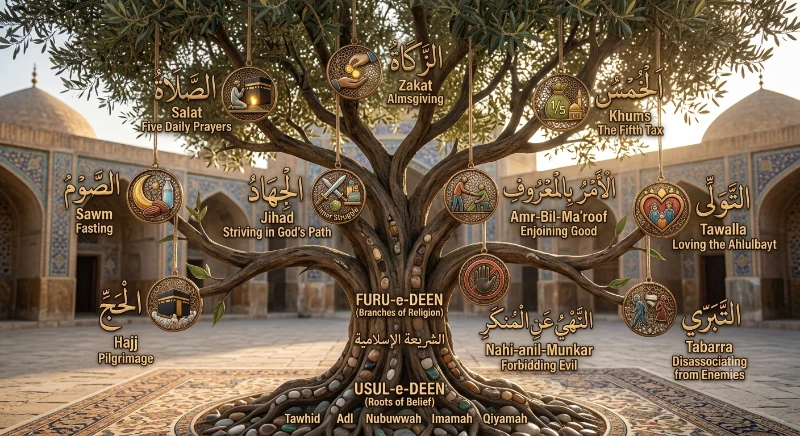
Here’s a walk-through of all ten, along with what the Quran and the Ahlul Bayt had to say about each one.
The Ten Furu-e-Deen
The following are the Ten Furu-e-Deen in Shia Islam, each serving as a practical branch of faith and obedience to Allah.
1. Salat — Prayer
Five times a day, a Muslim stops. Whatever else is happening — work, an argument, a deadline — prayer interrupts it. The Quran puts it plainly: “Indeed, prayer has been decreed upon the believers a decree of specified times” (Surah An-Nisa 4:103). And the Prophet Muhammad (s) went further, calling Salat the pillar of the entire religion — if it’s accepted, everything else a person does is accepted with it; if it’s rejected, nothing else even gets weighed. That’s a heavy claim for one act of worship, but it says something about how central this daily habit is meant to be.
2. Sawm — Fasting
Ramadan fasting isn’t really about hunger. It’s about noticing hunger — and then choosing, for once, not to solve it immediately. “O you who believe, fasting has been prescribed for you as it was prescribed for those before you, that you may attain Taqwa” (Surah Al-Baqarah 2:183). Imam Ali (a) used to point out that a fast which only empties the stomach and changes nothing else has missed the point entirely.
3. Khums — The One-Fifth Levy
This one tends to surprise people who aren’t familiar with Shia practice. A fifth of a person’s surplus annual income is set aside, not as a suggestion but as an obligation, and directed to the Ahlul Bayt’s line and to those in genuine need. The Quran is direct about it: “And know that whatever thing you gain, a fifth of it is for Allah, and for the Messenger, and for the near relative, and the orphans, and the needy, and the wayfarer” (Surah Al-Anfal 8:41). It’s a yearly reminder that whatever a person accumulates was never fully theirs to begin with.
4. Zakat — Almsgiving
Zakat and Salat show up together in the Quran so often it’s almost a refrain — “And establish prayer and give Zakat” (Surah Al-Baqarah 2:43) appears again and again. The Prophet (s) once called Zakat the bridge of Islam, meaning a person’s faith can’t really cross over from words into practice without it. Prayer connects you upward; Zakat connects you outward.
5. Hajj — Pilgrimage
Once in a lifetime, if health and finances allow it, every Muslim is expected to make the journey to Mecca. “And pilgrimage to the House is a duty owed to Allah by whoever is able to find a way there” (Surah Aal-e-Imran 3:97). What makes Hajj striking isn’t just the ritual itself — it’s the leveling. A billionaire and a laborer wear the same two pieces of white cloth and stand in the same crowd. Nobody’s rank travels with them.
6. Jihad — Struggle
The word gets misused constantly, which is a shame, because its real meaning is mostly about the fight nobody else can see — the one against your own worse instincts. The Quran says, “And strive for Allah with the striving due to Him” (Surah Al-Hajj 22:78). Imam Ja’far as-Sadiq (a) described the struggle against one’s own soul as the harder, greater battle — harder than any external one a person will ever face.
7. Amr bil Ma’ruf — Enjoining Good
Being a decent person quietly, on your own, isn’t quite enough in this framework. “Let there be a group among you who call to goodness, enjoin what is right, and forbid what is wrong” (Surah Aal-e-Imran 3:104). There’s an expectation baked into the religion that you nudge the people around you toward good too — gently, but actively.
8. Nahi anil Munkar — Forbidding Wrong
The flip side of the last one. The Prophet (s) said that whoever sees wrongdoing should try to change it with their hand; if that’s not possible, with their words; if that’s not possible either, at the very least with their heart — and that last option, he said, is the weakest form of faith a person can have. Silence, in other words, is not neutral.
9. Tawalla — Devotion to the Ahlul Bayt
Tawalla is love that actually shows up in behavior — devotion to Allah, the Prophet (s), and the Ahlul Bayt that shapes how a person actually lives, not just what they say they feel. “Say: I do not ask you for this any reward except love for [my] relatives” (Surah Ash-Shura 42:23). For Shia Muslims, this attachment to the Ahlul Bayt isn’t sentimental — it’s practically a compass.
10. Tabarra — Disassociation
And the other side of that same coin: distancing yourself from those who worked against the Ahlul Bayt and the truth they stood for. “You will not find a people who believe in Allah and the Last Day having affection for those who oppose Allah and His Messenger” (Surah Al-Mujadila 58:22). Loving one thing sincerely usually means being honest about what you can’t love alongside it.
Why This Matters More for Kids Growing Up in the West
A child in Karachi or Qom picks up a lot of this by osmosis — the call to prayer down the street, relatives who fast, a culture built around these rhythms. A child in Chicago or Manchester doesn’t get that for free. Their school, their friend group, their entire visual and cultural diet rarely reinforces any of this. If nobody sits down and actually explains it, it just doesn’t get absorbed.
And here’s the part that matters most: kids can smell an arbitrary rule from a mile away. Tell a ten-year-old “you have to pray” with no explanation, and you’ll get resistance or, worse, quiet resentment that surfaces later.
But explain that Khums is about not letting money own you, or that Salat is less a chore and more a standing appointment with someone who actually listens — that lands differently. Kids raised with the reasoning behind the Furu, not just the rules, tend to hold onto their faith through the teenage years and beyond, when everything else is pulling in a different direction.
What Actually Comes From Living This Way
None of this is abstract once you actually try to live it. Salat and Sawm build a kind of discipline that spills into the rest of life — the same self-control that gets you through a fast gets you through a hard conversation. Khums and Zakat loosen money’s grip on a person; it’s hard to stay obsessed with wealth you’ve committed to regularly giving away.
Hajj leaves people with a strange, humbling sense of how small their usual worries are. The inner Jihad builds a kind of resilience that no gym membership can replicate. Amr bil Ma’ruf and Nahi anil Munkar keep a community from going morally numb. And Tawalla and Tabarra together give a person something a lot of people are quietly missing these days — clarity about where they stand.
Closing Thoughts
The Ten Furu-e-Deen were never meant to be memorized and forgotten. They’re closer to a lifelong training program for character — the kind that turns “I believe in Islam” into an actual, visible way of living. Passing that on, especially to kids growing up far from the cultures that once made it automatic, might be one of the more important jobs any Muslim parent takes on.





- Be Respectful
- Stay Relevant
- Stay Positive
- True Feedback
- Encourage Discussion
- Avoid Spamming
- No Fake News
- Don't Copy-Paste
- No Personal Attacks
- Be Respectful
- Stay Relevant
- Stay Positive
- True Feedback
- Encourage Discussion
- Avoid Spamming
- No Fake News
- Don't Copy-Paste
- No Personal Attacks
