Duas to Recite During Umrah
Published: 21 Jul 2026
Dua is the heart of Umrah. The rituals give the pilgrimage its structure, but it is the quiet conversations with Allah at each stage that give it its soul. Many pilgrims arrive in Makkah with a list of duas they have never understood, reciting words without feeling them. This guide walks you through the duas recited at every stage of Umrah, with their meanings in plain English, so that when you stand before the Kaaba, you know exactly what you are saying and why.
One point to settle from the start: apart from a few established supplications, there is no fixed dua for each lap of Tawaf or each length of Sa’i. The Prophet ﷺ left most of these moments open, which means you are free and encouraged to pour out your own needs in your own language, including English.
The Dua of Travel: Beginning Your Journey from the UK
Your Umrah begins the moment you leave home, not when you land in Jeddah. As you set off for the airport, recite the traveller’s dua:
Subhanal-ladhi sakh-khara lana hadha wa ma kunna lahu muqrinin, wa inna ila Rabbina lamunqalibun.
“Glory be to the One who has placed this at our service, for we could never have done so ourselves, and to our Lord we shall surely return.” (Surah Az-Zukhruf, 43:13–14)
Reciting this on the plane sets the tone for the entire trip: everything ahead, from the flight to the rituals, happens only by the permission of Allah.
The Talbiyah: The Dua of Ihram
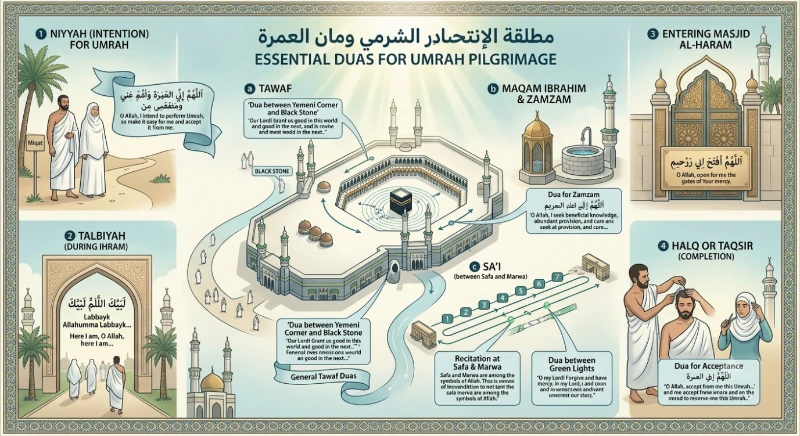
Once you enter the state of Ihram at the Miqat, the Talbiyah becomes your constant companion until you begin Tawaf:
Labbayk Allahumma labbayk. Labbayka la sharika laka labbayk. Innal-hamda wan-ni’mata laka wal-mulk. La sharika lak.
“Here I am, O Allah, here I am. Here I am, You have no partner, here I am. Indeed, all praise, blessing and sovereignty belong to You. You have no partner.”
Men raise their voices with it; women recite it softly. Say it in the airport, on the coach, in your hotel lift. Each repetition is an answer to the ancient call of Ibrahim (peace be upon him) inviting humanity to the House of Allah.
Which Dua Do You Recite When You First See the Kaaba?
There is no single authenticated dua fixed for this moment, and that is precisely the point. Scholars teach that the first sight of the Kaaba is a moment when duas are answered, so many pilgrims save their most heartfelt personal request for it. Raise your hands, praise Allah, send salutations upon the Prophet ﷺ, and ask for whatever matters most to you. Prepare this request before you travel so the emotion of the moment does not leave your mind blank.
Duas During Tawaf
Tawaf consists of seven circuits around the Kaaba, and no specific dua is prescribed for each one. Recite whatever you wish: Quran, dhikr, or personal supplications in English. There is, however, one established Sunnah dua for the stretch between the Yemeni Corner and the Black Stone in every circuit:
Rabbana atina fid-dunya hasanah, wa fil-akhirati hasanah, wa qina ’adhaban-nar.
“Our Lord, give us good in this world and good in the Hereafter, and protect us from the punishment of the Fire.” (Surah Al-Baqarah, 2:201)
After completing Tawaf, pray two rak’ahs behind Maqam Ibrahim if you can, or anywhere in the mosque if it is crowded, and then make dua freely.
The Dua of Zamzam
Drinking Zamzam after Tawaf is a Sunnah, and the Prophet ﷺ said that Zamzam water is for whatever it is drunk for. Many pilgrims recite the well-known supplication narrated from Ibn Abbas:
Allahumma inni as’aluka ’ilman nafi’an, wa rizqan wasi’an, wa shifa’an min kulli da’.
“O Allah, I ask You for beneficial knowledge, abundant provision, and cure from every illness.”
Duas During Sa’i Between Safa and Marwah
As you approach Safa for the first time, recite the verse that gives Sa’i its foundation:
Innas-Safa wal-Marwata min sha’a’irillah.
“Indeed, Safa and Marwah are among the symbols of Allah.” (Surah Al-Baqarah, 2:158)
On top of Safa, face the Kaaba, raise your hands, and declare the oneness of Allah:
La ilaha illallahu wahdahu la sharika lah, lahul-mulku wa lahul-hamdu, wa huwa ’ala kulli shay’in qadir.
“There is no god but Allah alone, without partner. To Him belongs the dominion and all praise, and He has power over all things.”
Repeat this three times with personal duas in between, and do the same each time you reach Safa and Marwah. The seven lengths in between are open time: remember Hajar, whose search between these very hills Allah loved so much that He made it a ritual forever, and ask Him for your own provision as she asked for hers.
Preparing Your Personal Dua List Before You Travel
The pilgrims who benefit most are the ones who arrive prepared. In the weeks before departure, write a dua list on your phone or in a small notebook: your family by name, your health, your work, your debts, your hopes, the people who asked you to pray for them. Sorting the practical side of the trip early gives you the headspace to do this properly, which is why many British pilgrims book early through current Umrah Deals rather than leaving flights and hotels to the last minute.
Travelling from the capital makes this easier still, with direct flights to Jeddah and a wide range of Umrah Packages from London available year-round, including Ramadan departures, when the reward of Umrah is likened to Hajj. The less you worry about logistics, the more of your heart is free for dua.
Frequently Asked Questions
Can I make dua in English during Umrah?
Yes. Outside of the fixed Arabic recitations such as the Talbiyah and prayers, you may supplicate in any language. Allah understands every tongue, and a sincere dua in English is better than an Arabic one you do not understand.
Is there a specific dua for each round of Tawaf?
No. Lists assigning one dua per circuit are a later custom, not a Sunnah. Only the dua between the Yemeni Corner and the Black Stone is established; the rest of Tawaf is open for your own dhikr and supplications.
When are duas most accepted during Umrah?
Cherished moments include your first sight of the Kaaba, during Tawaf and Sa’i, after drinking Zamzam, in sujood, and between the Adhan and Iqamah in the Haram.
Do women recite the Talbiyah aloud?
Women recite the Talbiyah quietly, loud enough for themselves to hear, while men are encouraged to raise their voices.
Final Thoughts
Umrah is a journey measured not in miles but in duas. Learn the established supplications, understand what they mean, and prepare your own list before you leave the UK. When you finally stand before the Kaaba with a ready heart and a ready tongue, every step of the pilgrimage becomes a conversation with the One who invited you.
May Allah accept your Umrah, answer your duas, and return you home with a heart fuller than the one you left with. Ameen.





- Be Respectful
- Stay Relevant
- Stay Positive
- True Feedback
- Encourage Discussion
- Avoid Spamming
- No Fake News
- Don't Copy-Paste
- No Personal Attacks
- Be Respectful
- Stay Relevant
- Stay Positive
- True Feedback
- Encourage Discussion
- Avoid Spamming
- No Fake News
- Don't Copy-Paste
- No Personal Attacks
